
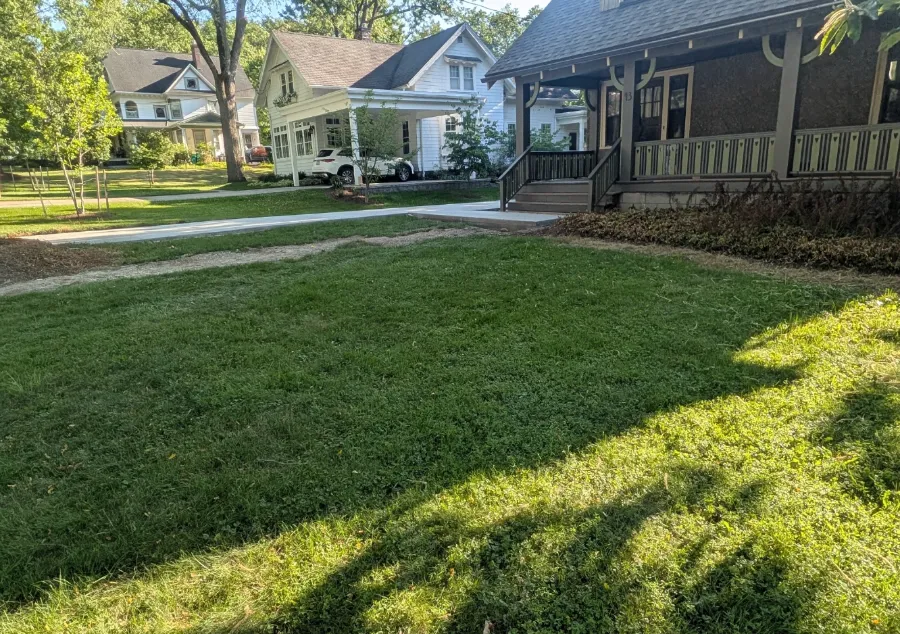
Yard staying soggy after every rain? We regrade yards so water runs away from the house, fill low spots and finish with topsoil and seed or sod, in West Seneca and the towns around it.
Why yards stay wet around here
Clay is the main reason. It is dense, holds water and drains slowly, so rain that would soak into sandy ground sits on top instead. Many lots in the Southtowns are also fairly flat, which gives water no reason to move.
Winter adds to it. Lake-effect snow piles up, then melts in a few days, often onto ground that is still frozen underneath. That water has nowhere to go but across the surface. Construction and utility work make it worse. Soil gets compacted by machines, and trenches from sewer or water line work settle over time into long, low channels that hold puddles.
Watch where the water goes first
Before fixing anything, find out what the water is actually doing. Go out during or right after a heavy rain and look. Where does it pool? Where does it come from? Does it run toward the house or away?
Note where downspouts empty and whether water from a neighbor's yard or the street flows onto yours. Photos help. A wet spot by the foundation is a different problem from a soggy corner at the back of the lot. Those notes also make a first visit far more useful, because we can see the pattern without waiting for the next storm.
Regrading: the fix for most standing water
When water pools or runs toward the house, the shape of the ground is usually the cause. Regrading reshapes the yard so it falls gently away from the foundation and toward a spot where water can safely leave or soak in.
That can mean cutting down high spots, building up low ones, and bringing in topsoil to set a smooth, even slope. Rock and debris come out along the way. Done right, it fixes the cause rather than the symptom. Our yard grading and lawn prep work is built around exactly this, and the finished grade is then seeded or sodded so it holds.
Low spots and settled trenches
Some wet areas are small and local. A dip where an old tree stump rotted out, a corner that was never filled, or a trench across the lawn after a sewer line replacement can each hold water long after the rest of the yard dries.
Trenches are common. Loose fill settles for months after the plumber leaves, and the lawn sinks with it. The fix is to fill and compact the low area in layers, regrade it to match the yard around it, and finish with seed or sod. We handle lawn repair after sewer line work this way, so the trench disappears and the water stops collecting there.
Simple fixes you can do yourself
Some drainage trouble has an easy cause. Downspouts that dump right next to the house are a big one. An extension that carries the water several feet out onto ground that slopes away can make a real difference.
Check planting beds along the foundation too. Over years of fresh mulch, beds can build up higher than the lawn and tilt water back toward the house. Pulling old mulch down and reshaping the bed so it falls away helps. Keep gutters clear in fall, after the leaves come down. And avoid driving or parking on a soft lawn, since every tire track compacts the clay a little more.
When it takes more than grading
Grading solves most surface water in residential yards, but not every problem. Water coming from a high water table, a spring, or a large area uphill may need more than reshaping the lawn.
If our walk-through shows a problem that grading alone will not fix, Patrick will tell you plainly, so you can plan the right next step. Most of the time, though, a yard that holds water simply needs the ground shaped correctly and a healthy lawn on top. For a related read, see how to level a yard. To have someone look at yours, call (716) 671-4971 or use the estimate form.
The short version
- Clay soil and flat or misgraded lots are behind most wet yards in Western New York.
- Watch where water goes during a heavy rain before choosing a fix.
- Regrading the yard away from the house solves most standing water.
- Settled trenches and low spots need filling, compacting and new grass.
- Downspout extensions and reshaped beds are easy homeowner fixes.
Quick answers
What is the most common fix for a soggy yard?
Regrading. Most wet yards here are clay ground shaped so water sits or runs the wrong way. Reshaping the slope and finishing it with grass fixes the cause.
Who do I call for yard drainage problems?
For water that pools on the lawn or runs toward the house, a landscaping crew that does grading is a good start. Kielty offers free estimates at (716) 671-4971.
Will adding topsoil fix standing water?
Only if it is used to reshape the slope. Spreading topsoil evenly over a low area just raises the puddle. The ground has to be graded so water moves away.
Can grading help keep water away from my basement?
Grading the yard away from the foundation helps keep surface water off the walls. Basement leaks can have other causes too, so a plumber or foundation specialist may also be worth a call.
Want this done for you? Patrick comes out, looks at the yard and talks through the options. The estimate is free.