
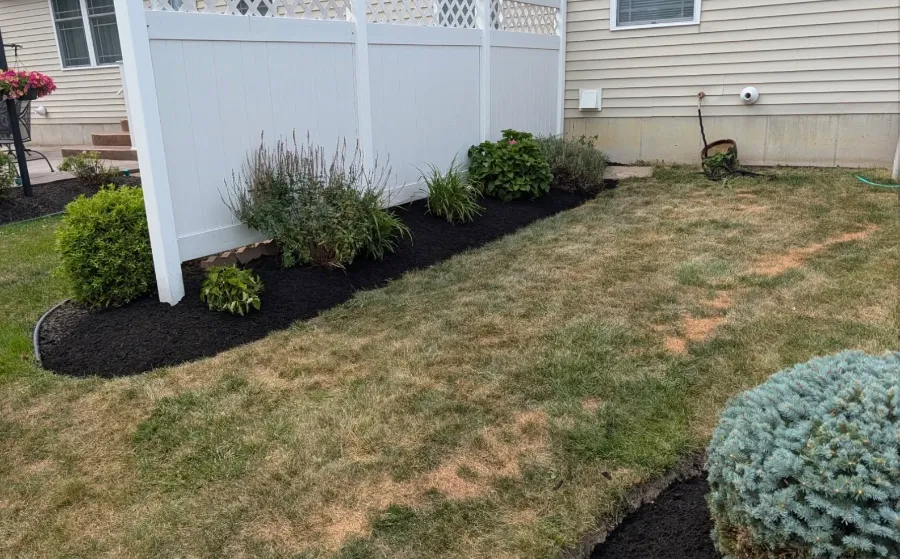
Want the foundation bed planned and planted for you? Patrick walks the property with you, and our own crew builds the bed and sets the plants, spaced for their size at maturity. The estimate is free.
Start with a deeper bed
Many houses in the Southtowns came with a narrow strip of soil along the foundation and a row of shrubs crammed into it. Within ten years those shrubs are up over the windows and pressing against the siding.
A foundation bed looks right and grows right when it has room. Pulling the lawn edge out gives space for two or three layers of plants instead of one straight row, and a gentle curve looks more natural than a ruler-straight line.
Deeper beds also give you a buffer for the drip line, where roof water and snow come off the eaves. Set the shrubs in front of that line, not under it, and use the strip closest to the wall for stone or mulch.
Space plants for their size in ten years
The tag on a nursery shrub tells you how big it gets. Believe it. A small globe in a pot can be a shrub several feet across before long, and planting for how it looks on day one is how foundations get swallowed.
Keep shrubs far enough from the wall that, at full size, air still moves between the plant and the house. That keeps siding dry, leaves room for painting or window cleaning, and stops roots from crowding the foundation.
Our recent jobs include a giant shrub that had swallowed a whole foundation bed before it was trimmed back and mulched. Choosing compact varieties from the start avoids that problem entirely.
Evergreens for structure all winter
From November to April, the front of a Western New York house is mostly gray and white. Evergreens carry the bed through those months.
Dwarf yews, boxwood, globe arborvitae and low spreading junipers are reliable foundation choices here. Yews handle shade on north-facing fronts. Junipers like full sun and dry spots. Boxwood stays neat with a single trim a year.
Place evergreens at the corners of the house and beside the front steps to frame the entry. Then leave gaps between them for seasonal color, rather than lining up evergreens shoulder to shoulder across the whole front.
Layer perennials and flowering shrubs in front
In front of the evergreens, layer plants that change through the year. Hostas and ferns brighten shady fronts. Daylilies, catmint, coneflower, sedum and black-eyed Susan handle sunny beds and clay soil well.
Ornamental grasses add height and movement and stand up through the snow, so the bed has something to look at in winter too. Cut them back in spring, not fall, if you like that winter look.
A flowering shrub or two, like a compact hydrangea or spirea, adds a summer show. Repeat the same few plants along the bed instead of using one of everything. Repetition looks planned, and it keeps trimming simpler because similar plants share the same schedule.
Plan for roof snow, plow piles and salt
Look at where snow comes off the roof and where it lands from the driveway and walk. Those spots get buried, crushed and soaked in salty meltwater every winter.
Under a valley where the roof sheds a load of snow, skip brittle upright shrubs. Low, flexible plants or perennials that die back to the ground handle the weight. Beside the driveway, where shoveled and plowed snow piles up, choose salt-tolerant plants or leave a strip of stone.
Upright arborvitae and junipers near the walk can be tied loosely for winter so they do not splay open. Small decisions like these are the difference between a bed that looks good in May and one that needs replacing every few springs.
Grade, drainage and what goes against the wall
Clay soil holds water, and water sitting against a foundation is the last thing you want. Before anything is planted, the soil in the bed should slope away from the house so rain runs toward the lawn.
Downspouts that dump straight into the bed will drown plants and soak the foundation. Extend them or direct them past the planting area.
Against the wall itself, a strip of stone or a clean mulch edge gives you a dry zone that is easy to inspect. Fresh mulch across the rest of the bed holds moisture where the roots need it. When we put in a new foundation bed through landscape installation, the grade and drainage come first, then the edging, plants and mulch.
The short version
- Make the bed deeper than the builder's strip so plants can layer.
- Space shrubs for their mature size and keep them off the siding.
- Use evergreens at corners and the entry for winter structure.
- Keep brittle shrubs out of roof snow and plow pile zones.
- Slope the soil away from the house before planting.
Quick answers
How far from the house should foundation plants be?
Far enough that, at full size, there is still air space between the plant and the wall. For most shrubs that means setting the center well out from the foundation, in front of the roof drip line.
What are good low shrubs for the front of a house in Western New York?
Dwarf yews, boxwood, globe arborvitae, low junipers and compact spirea are all reliable here. Pair them with tough perennials like daylily, catmint and sedum.
Should I use mulch or stone around my foundation?
Many beds use both: a narrow strip of stone right against the wall where water drips, and mulch across the planted area to hold moisture and feed the soil.
Can you redo an overgrown foundation bed instead of starting over?
Often, yes. Good mature shrubs can be trimmed back and kept, and the rest replaced. Our landscape design work regularly keeps what is worth keeping.
Want this done for you? Patrick comes out, looks at the yard and talks through the options. The estimate is free.