
Want river rock or stone edging put in for you? Decorative stone and granite cobblestone edging are part of our hardscaping work in West Seneca and the nearby towns, along with patios, walkways and walls.
What river rock does well
River rock is smooth, rounded stone in shades of tan, gray and brown. Unlike mulch, it does not break down, wash away in a downpour or float off in a puddle. That makes it a good choice for places that get hit with moving water or that you never want to redo.
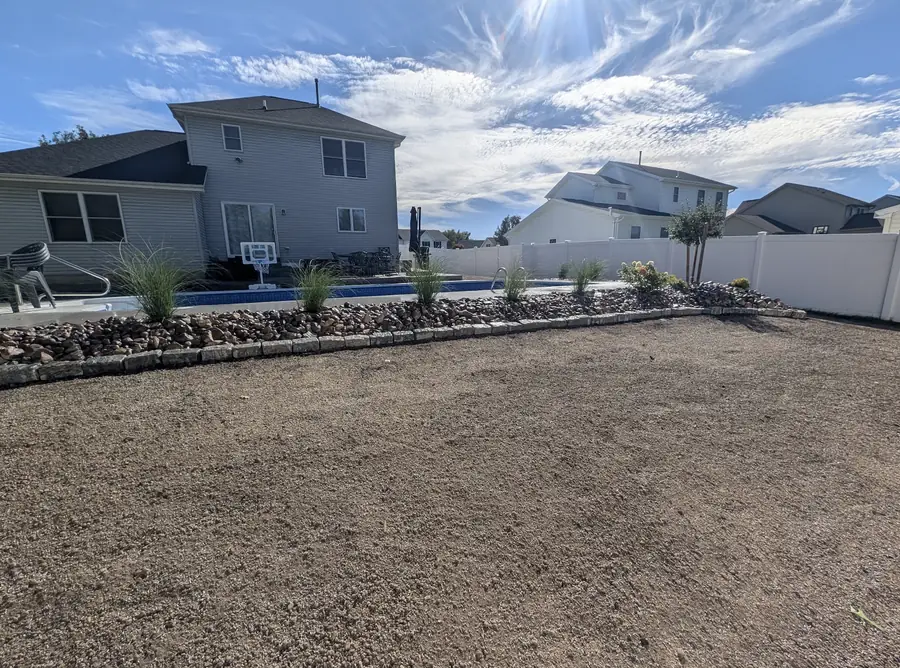
A real example from our own work: a backyard beside a brand-new pool had been left as hard-packed dirt and loose rock. We graded the yard smooth, then built a river rock bed along the pool with block edging and ornamental grasses, and left the rest ready for lawn. Next to a pool, mulch blows and floats into the water. Rock stays put, drains fast after a swim and looks clean against the deck. You can see that job on our yard grading page.
Foundations, downspouts and under the eaves
Along the house is where river rock earns its keep. Roof runoff from eaves without gutters, or from an overflowing gutter, digs holes in mulch and splashes soil onto the siding. Rock takes the hit and lets the water through. At the end of a downspout, a pad of larger rock slows the water down so it does not carve a channel into the lawn.
Rock also dries faster than mulch, so it does not hold damp material against the foundation. The one rule that matters more than the stone is the grade under it. The soil should slope away from the house before any rock goes down. Rock laid on ground that tips toward the basement just hides the problem, so we check that first.
Drainage swales: rock looks the part, grading does the work
Many homeowners line a wet strip of yard with river rock and expect it to drain. It will not, on its own. Water follows the slope of the ground. If the low spot has nowhere to go, it stays wet with or without stone on top.
What works is shaping the ground first. A shallow swale graded to carry water away from the house and toward a safe outlet can then be lined with river rock, which keeps the channel from eroding and makes it look like a dry creek bed instead of a ditch. In Western New York clay, that grading step is the whole fix. Our guide to yard drainage fixes explains how to read where the water goes and when regrading is the answer.
Where river rock is the wrong choice
Rock does nothing for the soil. In a bed of perennials, roses or shrubs you plan to move or divide, it gets in the way and adds no organic matter as the years go by. It also holds heat on sunny days, which some plants do not like.
Skip it under big shade trees, too. Maples and oaks drop a heavy load of leaves every fall, and leaves caught between rounded stones are hard to get out. On steep slopes, small rounded rock tends to roll downhill. Near the lawn, keep rock contained, because a stone kicked into the grass can be thrown by a mower. Right beside a driveway or walk that gets plowed or snow-blown, rock can be picked up and thrown in winter, so a border of edging or a strip of lawn between the two helps.
What goes under river rock: fabric and edging
Two things keep a rock bed looking good. The first is a layer of landscape fabric under the stone. It separates the rock from the clay below, so the stones do not slowly sink into the mud with each freeze and thaw. It also slows weeds coming up from the soil.
The second is solid edging. Without it, rock creeps into the lawn and soil creeps into the rock. On the pool job we used block edging. Granite cobblestone edging is another option we install, and it suits beds that border a walkway or patio. The ground is shaped and the edging set before the fabric and stone go in, so the bed has a clean, even line that holds through the winter. Rock beds are part of the decorative stone work on our hardscaping page.
Weeds, leaves and winter in a rock bed
Fabric stops weeds from below, but not from above. Over time, dust, grass clippings and bits of leaves settle between the stones and turn into a thin layer of soil, and weed seeds land and sprout in it. Pulling those few weeds while they are small, and clearing debris each spring and fall, keeps the bed from filling in.
For leaves, a blower on a low setting moves them off rock without scattering the stones. A hard rake tends to pull rock out with the leaves. In winter, rock handles Western New York weather well. It does not freeze into a mat like wet mulch, and it shows up clean again when the snow melts. Salt does not hurt the stone, but salty meltwater still reaches the plants growing in it, so pick tough plants for beds near the drive.
Mixing rock and plants, and choosing rock or mulch
Rock beds look better with plants in them. Ornamental grasses, like the ones on the pool job, and compact shrubs work well, because they stay put and do not need the soil worked every year. Cut an opening in the fabric for each plant and leave room around the stem.
A simple rule covers most yards. Use rock where water hits, where you want no upkeep, and where mulch would float or blow away. Use mulch in planting beds, where it feeds the soil and makes leaf cleanup easy. Many homes end up with both: rock at the drip line and mulch further out. Our guide to mulch for flower beds covers the planted side, and our mulching service keeps those beds fresh. For a free estimate on a rock bed, call (716) 671-4971.
The short version
- River rock suits drip lines, downspouts, swales, poolsides and side yards.
- It is a poor fit for perennial beds and under trees that drop heavy leaves.
- Rock does not drain a wet spot; grading the ground does.
- Landscape fabric and solid edging keep rock clean and in place.
- Rock and mulch often work together: rock where water hits, mulch where plants grow.
Quick answers
Is river rock better than mulch around a house foundation?
Often, yes. Rock handles roof runoff without washing away and dries faster than mulch. The soil under it still needs to slope away from the house.
Do you need landscape fabric under river rock?
In clay soil, yes. Fabric keeps the rock from sinking into the mud over time and slows weeds coming up from below. Weeds that sprout in debris on top still need pulling.
How do you get leaves out of a river rock bed?
Use a leaf blower on a low setting and clear the bed every fall and spring. Raking tends to pull stones out along with the leaves.
Will river rock fix standing water in my yard?
Not by itself. The ground has to be graded so water can flow away. A rock-lined swale works once the slope is right.
Want this done for you? Patrick comes out, looks at the yard and talks through the options. The estimate is free.