
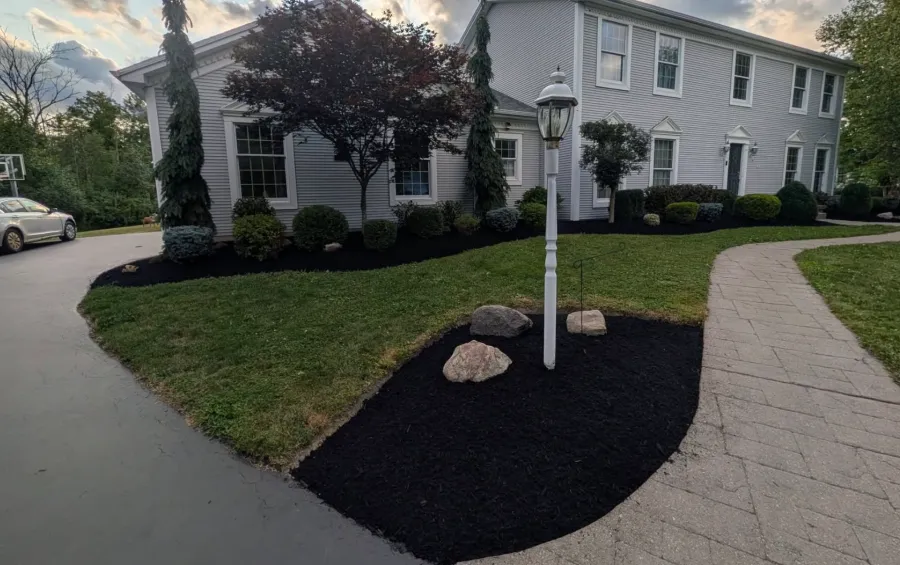
What a flower bed needs from its mulch
Flower beds are not the same as the stone strip along a driveway. Perennials get divided, bulbs come up through the layer, and annuals go in and out every year. The mulch has to be easy to pull aside and push back.
Here it also has to cope with our weather. Spring rain on heavy clay, a dry stretch in July and then months of freezing and thawing all test a bed. A good mulch holds moisture in summer, insulates the crowns of plants in winter, and keeps weeds from sprouting in the bare soil between them.
It should also feed the soil a little as it breaks down. Clay soils in the Southtowns benefit from that slow supply of organic matter year after year.
Shredded hardwood: the everyday workhorse
Double or triple shredded hardwood is what we reach for on most residential beds. The fibers lock together into a mat, so it stays on a slope and does not wash onto the lawn in a downpour the way loose chips can.
It breaks down at a steady pace, which means a light refresh each year instead of a full replacement. As it decays it adds organic matter to the soil, and the earthworms do the rest.
The one thing to watch is compaction. After a few seasons the bottom of the layer can pack into a crust that sheds water. Breaking it up with a rake before adding more, or taking it out when it is too deep, keeps it doing its job.
Bark, cedar and softer options
Pine bark nuggets look tidy and last a long time, but they are light. On a sloped bed or near a downspout they float and end up in the grass after the first big rain. They work better on flat ground away from water flow.
Cedar mulch has a pleasant smell and breaks down slowly. That slow pace is good for looks and less good for the soil, since it adds organic matter at a crawl.
Shredded leaves and compost are the gardener's choice. They feed the soil fast and cost you nothing if you save your own leaves in fall. The trade-off is appearance. Most homeowners use them under a thin top layer of shredded hardwood so the bed still looks finished from the street.
Dyed mulch: black, brown and red
Dyed mulch is shredded wood with a colorant added. Black and dark brown are the most popular here because they make green foliage and bright flowers stand out against the house.
The color fades with sun and rain, so expect it to look lighter by late summer. A thin top dressing in spring brings it back without piling on depth.
The bigger question with dyed mulch is the wood underneath. Some low-grade products are made from ground-up pallets and construction scrap, which break down unevenly. Buy from a supplier who can tell you what the wood source is. On the beds we finish with mulching services, black mulch is a common request and it looks sharp next to fresh edging.
Stone and rubber in flower beds
Decorative stone has its place: around foundations where water drips, along driveways, and in commercial beds where nothing gets replanted. In a perennial bed it causes problems. Stone holds heat in summer, does nothing for the soil, and turns every fall leaf and grass clipping into a picking job.
Once soil and debris settle into the gaps, weeds grow in the stone itself. Getting it out later, if you change your mind, is heavy work.
Rubber mulch never breaks down, which sounds like a benefit until you want to plant something new or improve the soil. It also does not feed the bed at all. For flower beds, an organic mulch is almost always the better fit.
When to mulch flower beds here
Spring mulching should wait until the soil has thawed and started to dry out. Sealing cold, wet clay under a fresh layer slows warming and keeps the bed soggy longer. Late April into May is usually about right, after perennials have poked through and the cleanup is done.
A fall layer, put down after the beds are cleaned out and cut back, protects roots through freeze and thaw cycles and keeps the beds looking finished all winter.
Either way, aim for 2 to 3 inches and keep it pulled back from stems. Our guide to how much mulch you need walks through the math so you order the right amount.
The short version
- Shredded hardwood is the most practical everyday mulch for flower beds in Western New York.
- Pine bark nuggets float off slopes and onto lawns in heavy rain.
- Dyed mulch is fine; ask what wood it is made from.
- Stone and rubber suit driveways and commercial beds better than perennial beds.
- Mulch in spring once the soil dries out, and again in fall after the cleanup.
Quick answers
What is the best mulch for flower beds?
For most homes in Western New York, double or triple shredded hardwood. It stays in place, holds moisture, insulates roots and slowly improves clay soil as it breaks down.
Is black mulch bad for plants?
The color itself is generally not the issue. The thing to check is the wood source, since some cheap dyed mulch is made from scrap wood. Good quality black mulch performs like any other shredded hardwood.
Should I use rock or mulch in flower beds?
Mulch. Rock holds heat, adds nothing to the soil and traps leaves and debris. Save stone for drip lines, driveway edges and low-care commercial beds.
When should I mulch my flower beds?
In spring once the soil has thawed and dried a bit, usually late April or May here, and again in fall after the cleanup. Our landscape maintenance visits can fold both into the season.
See our mulching service or call (716) 671-4971.