Leaning toward pavers? We build paver patios on a dug-out, compacted base in West Seneca, Orchard Park, Hamburg, Lancaster and East Aurora, planned with the beds and lawn around them.
Is it cheaper to pour concrete or install pavers?
For a plain slab of the same size, concrete is usually cheaper to put in. The forms go up, the base goes down, the concrete is poured and finished in one go. Pavers take more labor, because each one is set by hand on a carefully leveled bed.
The gap narrows once you count the whole life of the patio. A cracked slab is hard to fix without tearing it out. Pavers can be lifted, the base corrected and the same pieces reset. Decorative concrete with stamping or color also costs more than a plain pour. So the real question is how long you plan to stay and how much a crack would bother you.
How each one handles freeze-thaw
Western New York ground freezes and thaws many times a winter. Wet clay swells as it freezes and drops back as it thaws. A concrete slab is one rigid piece, so when the ground moves unevenly, the slab cracks. Control joints help direct those cracks, but they do not stop them.
Pavers are many small pieces with joints between them. When the ground shifts a little, the joints absorb it and the surface flexes instead of splitting. Neither option is immune to a bad base. A paver patio on thin, poorly compacted stone will still heave. Built on a deep, compacted base, though, pavers usually come through a lake-effect winter looking the same as they did in the fall.
Repairs and long-term upkeep
Concrete needs little care day to day, but repairs show. Patching a crack or a sunken corner rarely matches the old surface, and big damage often means breaking out a whole section.
Pavers are the opposite. They may need joints topped up now and then, and a few may need resetting after a hard winter. When a spot settles, the pavers come up, the base is fixed and the same pieces go back down. Utility work is easier too. If a line under the patio ever needs digging, pavers can be pulled and replaced. A slab has to be cut. For a patio you want to keep for a long time, that repairability is the biggest point in favor of pavers.
Looks and design options
Plain concrete is clean and simple. Stamped and colored concrete can mimic stone, but the color can wear in high-traffic spots and the pattern is fixed once poured.
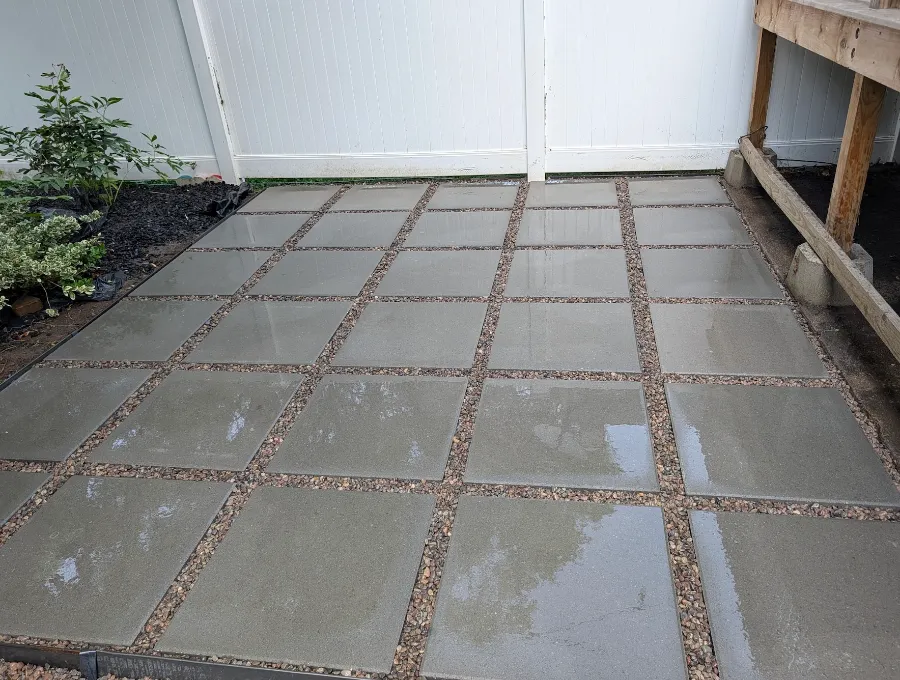
Pavers offer a wide range of shapes, sizes, colors and textures, and they can be mixed. Borders, curves and steps are easy to work in. Joints can be sand or something more distinctive. One of our recent patios used large pavers with pea gravel glued between them, which looks clean and lets rain drain through. Because pavers tie in easily with walkways, edging and planting beds, they suit a patio that is designed together with the yard around it.
The base matters under both
A patio is only as good as what it sits on. Both concrete and pavers need the soil dug out and replaced with compacted stone. In clay soil, skimping here is the most common reason either one fails.
Water is the other half. A patio should be pitched slightly so rain runs off and away from the house, not toward it. If the yard already holds water near the patio spot, that has to be dealt with first, often by regrading. We look at slope and drainage on the first visit, before anyone picks a material.
Which one fits your yard
Concrete makes sense for a basic slab where budget is tight and looks matter less. Pavers make sense when you want the patio to last, to be repairable, and to look like part of the landscape rather than an add-on.
Our hardscape work centers on paver patios, walkways, walls and stone edging, planned together with the beds and lawn. If you are weighing the two, call (716) 671-4971 or send a few details. Patrick will look at the spot and talk through what will work. See our paver patios for how we build them.
The short version
- Plain concrete usually costs less upfront than pavers.
- Pavers flex with freeze-thaw; a rigid slab tends to crack.
- Pavers can be lifted and reset, while concrete repairs rarely match.
- Both fail on a thin base, so excavation and compaction matter most.
- Pavers suit a patio planned as part of the whole landscape.
Quick answers
Is it cheaper to pour concrete or install pavers?
Concrete is usually cheaper to install for a plain slab. Pavers cost more upfront but are easier to repair, which can even out over the life of the patio.
Do pavers last longer than concrete in Buffalo winters?
On a proper compacted base, pavers usually handle freeze-thaw better, because the joints let them flex. A slab is rigid and more likely to crack as the ground moves.
Can pavers go over an old concrete patio?
Sometimes, if the slab is sound, level and drains well. A cracked or sunken slab usually needs to come out first. We check this on the free visit.
Which is easier to shovel?
Both shovel fine. A smooth slab is a little easier, but pavers with tight joints and a plastic-edged shovel cause no trouble.
Want this done for you? Patrick comes out, looks at the yard and talks through the options. The estimate is free.